Why Your Tech Startup Needs a Brand Strategy
The developer tools and SaaS market is one of the most crowded spaces in tech. There are over 30,000 SaaS companies worldwide, and that number keeps growing. If you are building a tech startup, your product alone will not differentiate you. Plenty of competitors have solid features, clean UIs, and reasonable pricing. The difference between the startup that gains traction and the one that fades into noise is often the brand.
A brand strategy matters for tech startups for three specific reasons. First, trust is everything in B2B tech. Companies are handing you their data, their workflows, and sometimes their entire operational infrastructure. They need to trust you before they sign. Your brand is how you build that trust before they ever talk to sales.
Second, investors evaluate brand clarity. A startup that can articulate who it is, who it serves, and why it matters is easier to bet on. Your pitch deck gets stronger when your brand strategy is already defined. VCs see hundreds of pitches. The ones that stick have a clear, differentiated brand story.
Third, hiring depends on brand. Top engineers and designers have options. They join companies whose mission resonates with them. A strong brand strategy gives potential hires a reason to choose you over a bigger company with a bigger paycheck.
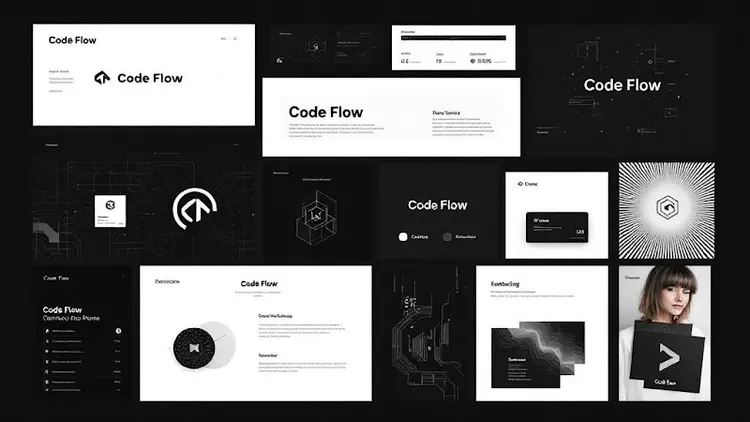
Throughout this article, we will reference a brand strategy deck created for Code Flow, a fictional AI-powered project management tool built for developer teams. Each section includes the actual strategy slide so you can see what a finished tech startup brand strategy looks like in practice.
Define Your Brand Purpose
Your brand purpose answers the question: Why does your tech startup exist beyond generating revenue?
In tech, purpose often ties back to a real problem the founders experienced firsthand. Maybe your team struggled with fragmented project management tools. Maybe you watched developers waste hours on tasks that should be automated. The best tech brand purposes are rooted in genuine frustration with the status quo.
Purpose is not a feature list. It is not about what your product does. It is about the change you want to create. Stripe exists to increase the GDP of the internet. Notion exists to make toolmaking ubiquitous. These are purpose statements that go beyond product functionality.
For developer-focused startups, purpose often centers on removing friction. Developers hate unnecessary complexity. A purpose that speaks to simplifying workflows, eliminating busywork, or empowering teams to ship faster resonates because it addresses a real pain point that your audience deals with daily.

Notice how Code Flow's purpose is not about features or technology specs. It focuses on the outcome: empowering individuals and organizations to achieve their full potential. That framing guides product decisions, marketing copy, and hiring priorities.
Set Your Brand Vision
If purpose is your "why," vision is your "where." It describes the future state you are working toward. For a tech startup, your vision should be ambitious enough to inspire but grounded enough to be credible.
Tech visions often fail in one of two ways. They are either too vague ("We want to change the world") or too narrow ("We want to be the best Kanban board"). The sweet spot is a vision that defines a clear category leadership position while leaving room for the product to evolve.
Your vision also plays a practical role in fundraising. Investors want to know where you are headed. A well-articulated vision tells them the market size you are going after and the scale of ambition behind the company. It signals that you are thinking beyond the current MVP.

Code Flow's vision positions the company as a future global leader in AI-powered project management. It is specific enough to be actionable (AI project management tools) but broad enough to encompass multiple products and market segments over time.
Establish Core Values
Core values in tech are often dismissed as corporate decoration. That is because most companies pick generic words like "excellence" and "integrity" without defining what those mean in practice. Effective core values are decision-making tools.
For tech startups, values should address the tensions unique to your industry. Here are the tensions that matter most:
- Innovation vs. stability: Do you ship fast and break things, or do you prioritize reliability? Both are valid, but your values should make the answer clear.
- Transparency vs. competitive advantage: How open are you about your roadmap, pricing, and technical architecture? Open-source companies and proprietary SaaS companies answer this very differently.
- Speed vs. quality: When a deadline is tight, do you cut scope or push the timeline? Your values should pre-answer this question.
- Customer-centric vs. product-led: Do you build what customers ask for, or do you build what you believe is right and educate the market? Your values should guide this balance.

Code Flow chose five values: Innovation, Collaboration, Customer-Centric, Transparency, and Continuous Improvement. These are not random. They reflect the company's position as an AI tool that helps teams work together. Each value directly maps to how the product is built and how the company operates.
Identify Your Target Audience
Tech startups often make the mistake of defining their audience too broadly. "Companies that need project management" includes almost every business on the planet. That is not useful for making branding or marketing decisions.
Your target audience definition should be specific enough to guide content creation, ad targeting, event sponsorship, and sales outreach. In B2B tech, you are typically selling to multiple stakeholders: the end user (often a developer or team lead), the evaluator (a technical decision maker), and the buyer (a CTO, VP of Engineering, or CFO).
Your brand strategy should identify your primary audience and describe them in terms of:
- Company profile: Industry, size, growth stage, tech maturity
- Role and seniority: Who actually discovers, evaluates, and champions your product
- Pain points: What specific problems keep them up at night
- Decision criteria: What factors determine whether they choose you or a competitor
- Where they spend time: Which communities, publications, events, and platforms they engage with

Code Flow targets digitally focused businesses that operate remotely. This is specific enough to inform marketing channels (remote work communities, developer Slack groups, tech podcasts) without being so narrow that it limits growth potential.
Craft Your Brand Positioning
Positioning is the single most important element of your brand strategy. It defines what space your startup occupies in the customer's mind relative to alternatives.
In tech, positioning decisions usually fall along a few key axes:
- Enterprise vs. SMB: Are you building for Fortune 500 companies or for startups and small teams?
- Open source vs. proprietary: Is your code public? Do you offer a community edition?
- Horizontal vs. vertical: Do you serve all industries or specialize in one?
- Simple vs. powerful: Are you the easy-to-use option or the feature-rich option?
- AI-native vs. AI-enhanced: Is AI your core differentiator or an added layer?
Strong positioning requires making deliberate choices. You cannot be both the simplest and the most powerful tool. You cannot be both the cheapest and the most premium. Trying to be everything makes you nothing in the customer's mind.

Code Flow positions itself as a pioneering tech startup that prioritizes user experience and leverages AI seamlessly. This positioning draws a clear line against competitors that bolt AI onto legacy interfaces. It says: we are AI-native, and we care deeply about how the product feels to use. That is a position a team can rally around and customers can remember.
Set Marketing Goals
Your brand strategy needs marketing goals that connect directly to business outcomes. For tech startups, the marketing playbook looks very different depending on your go-to-market motion.
Product-led growth (PLG) startups focus on goals like free trial signups, activation rates, and self-serve upgrades. Their brand needs to communicate value quickly and reduce friction in the signup flow.
Sales-led startups focus on goals like marketing-qualified leads, demo requests, and pipeline value. Their brand needs to build credibility and trust before the first sales call happens.
Community-led startups focus on goals like developer community growth, open-source contributions, and brand mentions. Their brand needs to feel authentic and developer-friendly.
Most tech startups use some combination of these. The key is defining which marketing goals matter most at your current stage and making sure your brand strategy supports them. A seed-stage startup building developer tools should probably prioritize community and content over enterprise sales enablement.

Code Flow's marketing goal is direct: establish the product as a serious competitor to established platforms like Trello and Asana. This clarity is valuable because it shapes every marketing decision. Content topics, comparison pages, feature marketing, and PR angles all work toward this single objective.
Define Brand Personality
Tech brands often fall into one of two traps. They are either so corporate that they feel lifeless, or so casual that they do not feel trustworthy. The best tech brands find a specific point on the spectrum that matches their audience and product category.
Consider where the major tech brands sit. Slack is playful and approachable. AWS is technical and authoritative. Linear is minimal and opinionated. Notion is creative and flexible. Each personality matches the product experience and resonates with the target audience.
For developer-focused tools, personality often needs to balance two qualities: technical competence and human approachability. Developers respect brands that clearly understand their world. But they also respond to brands that do not take themselves too seriously. The worst thing a dev tool brand can be is condescending or marketing-heavy.
Define your personality with enough specificity that a new hire could write a tweet in your brand voice on day one. "Professional but friendly" is too vague. "A sharp engineer who explains complex concepts clearly, cracks dry jokes in pull request comments, and genuinely cares about developer experience" gives your team something to work with.

Code Flow's personality blends professionalism and friendliness, with a focus on innovation and approachability. This works for their positioning because they want to be seen as both cutting-edge (AI-powered) and easy to work with (great UX). The personality reinforces the product promise.
Develop Tone of Voice
Tone of voice is where your brand personality becomes tangible. For tech startups, tone shows up in places that many founders overlook:
- Documentation: This is often the first deep interaction a developer has with your brand. Clear, well-structured docs signal competence.
- Error messages: How your product communicates when something goes wrong reveals your brand character.
- Changelog and release notes: Are these dry lists of features, or do they tell a story about what you shipped and why?
- Blog posts and tutorials: Are you teaching or selling? Developer audiences can tell the difference immediately.
- Social media: Are you sharing value or just promoting? The best tech brands on social media are useful first and promotional second.
- Sales emails: Do they read like templates or like a real person wrote them?
Your tone of voice guide should specify how you sound across each of these channels. A blog post can be more conversational than documentation. A tweet can be more casual than a sales email. But the underlying personality should remain consistent.

Code Flow's tone of voice is casual and enthusiastic, reflecting the brand's approachable nature and genuine passion for innovation. This tone would work well in blog posts, social media, and community interactions. For documentation and enterprise sales materials, the team would dial up the precision while keeping the enthusiasm.
Create a Brand Tagline
A tagline for a tech startup needs to do two things: communicate what you do and hint at why you are different. It needs to work in a website header, a conference booth banner, and a Twitter bio.
The best tech taglines are short and specific. They avoid buzzwords that could apply to any company. Here is a simple test: if you could swap your tagline onto a competitor's website and it would still make sense, it is not specific enough.
Common patterns that work for tech startups:
- Outcome-focused: Describes the result, not the feature ("Ship faster" rather than "AI-powered CI/CD")
- Contrast-based: Positions against the status quo ("The database that scales itself")
- Category-defining: Names a new category you want to own ("The modern data stack")

Code Flow's tagline, "Elevate efficiency. Simplify collaboration," works because it speaks to the two core value propositions: getting more done (efficiency) and working better together (collaboration). It is short, memorable, and directly relevant to the product experience.
Once you have all these elements defined and documented, you have a complete brand strategy deck. This becomes the reference document for every branding decision going forward, from your website copy and product messaging to your pitch deck and hiring page.
Key Takeaways
- Brand strategy comes before visual identity. Define your purpose, positioning, and personality before you design a logo or pick brand colors.
- Tech startups need brand strategy for trust, fundraising, and hiring, not just marketing. Your brand influences every stakeholder interaction.
- Positioning requires trade-offs. You cannot be the simplest, most powerful, cheapest, and most premium option. Pick your lane.
- Your audience definition should be specific enough to guide content, ad targeting, and sales outreach. "Everyone" is not a target audience.
- Tone of voice shows up in documentation, error messages, and changelogs, not just marketing copy. Every touchpoint is a brand touchpoint.
- Use AI tools like Brand Strategist AI to build a complete strategy deck in minutes, then refine and customize it for your startup.
Build Your Tech Startup Brand Strategy
Brand Strategist AI walks you through every step and generates a professional strategy deck automatically. No branding experience needed.
Try Brand Strategist AI FreeFrequently Asked Questions
What should a tech startup brand strategy include?
A tech startup brand strategy should include your brand purpose, vision, core values, target audience definition, brand positioning, marketing goals, brand personality, tone of voice, and a tagline. These elements work together to guide product messaging, developer relations, sales materials, and all external communications.
How much does it cost to brand a tech startup?
Traditional branding agencies charge between $10,000 and $100,000+ for tech startup brand strategy and identity work. AI-powered tools like Brand Strategist AI can help you develop a professional brand strategy for a fraction of that cost, which is especially valuable for pre-seed and seed-stage startups with limited budgets.
How do I differentiate my tech startup from competitors?
Differentiation starts with brand positioning. Identify where competitors fall short, whether that is user experience, pricing transparency, developer support, or integration capabilities. Then position your brand to own that gap. The strongest tech brands differentiate on values and experience, not just features.
Can I use AI to create a brand strategy for my tech startup?
Yes. AI brand strategy tools can guide you through defining your purpose, vision, target audience, positioning, and personality in minutes. The output gives you a professional strategy deck you can present to co-founders, investors, and your team to align everyone on brand direction before spending money on design and marketing.