Why Your Skincare Brand Needs a Brand Strategy
The skincare market is projected to exceed $200 billion globally. New DTC brands launch every week. Consumers are flooded with serums, moisturizers, and cleansers that all promise glowing, healthy skin. In a market this crowded, product quality alone is not enough to win.
What separates brands that thrive from those that disappear after one product run? A clear brand strategy. Skincare customers are more informed than ever. They read ingredient lists. They research brands on social media before purchasing. They care about whether a brand is cruelty-free, sustainable, and transparent about sourcing. If your brand does not have clear answers to these questions, you lose the sale to someone who does.
A brand strategy is the foundational document that defines who you are, what you stand for, who you serve, and how you communicate. It is not a logo or a color palette. Those come later. Strategy comes first. Without it, every decision about packaging, marketing, and product development becomes a guess.
Skincare is also uniquely personal. People put your product on their face. That requires a level of trust that most consumer categories do not demand. A brand strategy is how you build that trust systematically, rather than hoping it happens on its own.
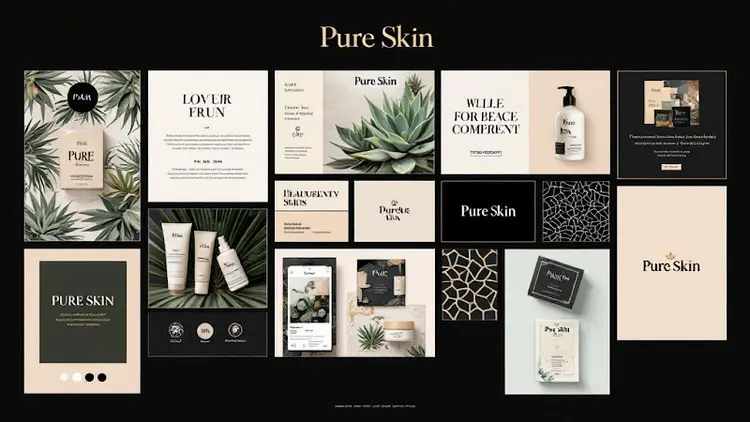
Throughout this article, we will reference a brand strategy deck created for Pure Skin, a natural skincare brand focused on harnessing the power of nature. Each section includes the actual strategy slide so you can see what a finished skincare brand strategy looks like in practice.
Define Your Brand Purpose
Your brand purpose answers one question: Why does your skincare brand exist beyond selling products?
In skincare, purpose matters more than in most industries. Consumers increasingly choose brands that align with their values. A purpose rooted in clean beauty, skin health education, or sustainable ingredient sourcing gives people a reason to choose you over the hundreds of alternatives on the shelf.
Your purpose is not a marketing slogan. It is the honest reason you started this brand. Maybe you struggled with sensitive skin and could not find products without harsh chemicals. Maybe you wanted to make clinical-grade skincare accessible to people who cannot afford dermatologist visits. Whatever your reason, write it down in clear, simple language.
A strong purpose also keeps your team aligned. When you are deciding whether to use a cheaper synthetic ingredient or invest in a natural alternative, your purpose gives you the answer without debate.

Notice how Pure Skin's purpose is not about selling moisturizers. It is about harnessing the power of nature to nourish and enhance natural beauty. That purpose shapes every product decision, from ingredient sourcing to packaging materials.
Set Your Brand Vision
If purpose is your "why," vision is your "where." Your brand vision describes the future state you are working toward. It should be ambitious enough to inspire your team but grounded enough to feel achievable.
For a skincare brand, your vision might focus on shifting the industry toward cleaner ingredients, making professional-grade skincare accessible to everyone, or becoming the most trusted name in a specific skin concern category like acne, aging, or hyperpigmentation.
Your vision also serves as a strategic filter. Every major decision, from which retailers to pursue to which product lines to develop, should move you closer to your vision. If it does not, it is a distraction.

Pure Skin's vision is about leading a transformation in the skincare industry. That is a big, clear direction. It tells the team that they are not just making products. They are building a movement toward natural skincare. That distinction matters when you are making decisions about partnerships, product formulations, and marketing campaigns.
Establish Core Values
Core values are the non-negotiable principles that guide your brand's behavior. In skincare, values carry extra weight because consumers use them to judge whether they can trust you with their skin.
The beauty industry has a history of misleading claims and greenwashing. Consumers are skeptical. Your core values need to be specific, actionable, and visible in everything you do. Generic values like "quality" and "innovation" mean nothing if they do not translate into real decisions.
Here are value areas that matter in skincare branding:
- Ingredient transparency - Full disclosure of what goes into every product and why
- Cruelty-free practices - No animal testing at any stage of development
- Sustainability - Responsible sourcing, recyclable packaging, reduced environmental impact
- Efficacy - Products that deliver measurable results, backed by testing
- Authenticity - Honest marketing without exaggerated claims or misleading before-and-after photos
Pick three to five values. More than that dilutes their usefulness as decision-making tools. Each value should be something you can point to in a real business decision you have made.

Pure Skin chose transparency, integrity, authenticity, sustainability, and innovation. These are not just words on a slide. They directly inform decisions like listing every ingredient with its purpose on product packaging, choosing recycled materials for bottles, and never retouching skin texture in marketing photos.
Identify Your Target Audience
You cannot build a skincare brand for everyone. A 19-year-old dealing with hormonal acne has completely different needs, concerns, and shopping habits than a 50-year-old looking for anti-aging solutions. Trying to speak to both equally will make your brand forgettable to both.
A strong target audience definition for a skincare brand includes three layers:
- Demographics - Age range, gender, income level, location
- Skin concerns - Acne, dryness, sensitivity, aging, hyperpigmentation, oiliness
- Lifestyle and values - Clean beauty advocates, ingredient-conscious shoppers, wellness-focused consumers, busy professionals who want simple routines
The lifestyle layer is where most skincare brands fail to go deep enough. Two women might both have dry skin, but one wants a five-step Korean skincare routine while the other wants one product that does everything. Your brand positioning, product line, and marketing content should be tailored to one of these profiles, not both.

Pure Skin targets young females aged 15 to 45 who prioritize natural and organic skincare. That is a clear audience with a shared value (natural ingredients) and a broad enough age range to support multiple product lines while still maintaining a focused brand message.
Craft Your Brand Positioning
Positioning answers the question: What space does your skincare brand occupy in the customer's mind?
In skincare, positioning decisions typically fall along a few key spectrums:
- Clinical vs. natural - Are you a science-driven brand or a nature-inspired brand?
- Luxury vs. accessible - Are you premium or democratized skincare?
- Niche vs. broad - Do you solve one skin concern deeply or offer a full routine?
- Minimalist vs. multi-step - Do you simplify routines or embrace a comprehensive approach?
You do not need to pick the extreme end of any spectrum, but you do need to commit to a direction. Brands that try to be both clinical and natural, both luxury and affordable, end up occupying no clear position at all.
Study your competitors. Identify gaps. If every brand in your price range leans clinical, there may be an opportunity to be the approachable, nature-forward alternative. If the natural skincare space in your market is dominated by luxury pricing, being the accessible natural option could be your opening.

Pure Skin positions itself as a trailblazing natural brand offering premium organic products. That is a clear position: natural, premium, and standard-setting. It tells customers exactly what to expect and helps the team make consistent decisions about pricing, ingredients, and retail partnerships.
Set Marketing Goals
Your brand strategy needs specific, measurable marketing goals tied to business outcomes. In skincare, marketing is especially critical because customer education drives purchasing decisions. People do not buy a serum they do not understand.
Common marketing goals for skincare brands include:
- Build social proof through customer reviews, user-generated content, and before-and-after results
- Grow brand awareness through influencer partnerships with beauty creators and dermatologists
- Educate consumers about ingredients, skin concerns, and proper product usage
- Drive DTC sales through email marketing, social commerce, and a high-converting website
- Build community around shared skin health goals and clean beauty values
Each goal should have a timeline and a metric. "Grow social media presence" is vague. "Reach 50,000 Instagram followers in 12 months through influencer collaborations and educational content" is actionable.

Pure Skin's marketing goals center on influencer collaborations, particularly with YouTubers and social media creators in the beauty space. This is a smart approach for a natural skincare brand because beauty influencers provide both reach and credibility. Their audiences already trust their product recommendations.
Define Brand Personality
If your skincare brand were a person, who would they be? Brand personality determines how your brand feels to customers across every interaction, from your website copy to your Instagram stories to the insert card inside your product box.
Skincare brand personalities generally fall into a few archetypes:
- The Clinical Authority - Science-driven, precise, data-backed. Think white coats and lab imagery.
- The Nurturing Friend - Warm, empathetic, supportive. Focuses on self-care and feeling good in your skin.
- The Clean Beauty Advocate - Passionate, transparent, mission-driven. Leads with values and ingredient education.
- The Luxury Expert - Sophisticated, refined, exclusive. Premium experience at every touchpoint.
The key is to pick a personality and commit to it. A brand that sounds clinical on its website but playful on Instagram confuses customers. Consistency builds trust, and trust is the currency of skincare.

Pure Skin's personality is gentle, nurturing, sophisticated, trustworthy, and empowering. This combination works well for a natural skincare brand. It signals that the brand cares about your skin (nurturing), knows what it is doing (sophisticated and trustworthy), and wants you to feel confident (empowering). That personality should show up in every product name, every email subject line, and every customer service interaction.
Develop Tone of Voice
Tone of voice is how your brand personality sounds in words. It is the difference between a product description that says "This serum contains hyaluronic acid for hydration" and one that says "Your skin is thirsty. This serum delivers deep hydration with pure hyaluronic acid so your complexion feels plump, bouncy, and alive."
Both communicate the same ingredient benefit. But they signal very different brands. Your tone of voice should be documented with clear guidelines and examples across key contexts:
- Product descriptions - How do you explain ingredients and benefits?
- Social media - How do you engage with followers and respond to comments?
- Ingredient education - How do you explain complex skincare science in an accessible way?
- Customer support - How do you handle concerns about irritation, allergic reactions, or product issues?
- Email marketing - How do you balance promotion with education and value?

Pure Skin's tone is caregiver-inspired, striking a balance between warmth, empathy, and informative guidance. This is a strong choice for a natural skincare brand. Customers want to feel cared for, but they also want clear information about what they are putting on their skin. A caregiver tone achieves both without sounding clinical or condescending.
Create a Brand Tagline
A tagline is a short, memorable phrase that captures your brand's essence. For skincare brands, the best taglines communicate a benefit or value proposition in a way that resonates emotionally.
Good skincare taglines tend to do one of these things:
- Speak to a desired outcome (healthy, glowing skin)
- Reinforce the brand's ingredient philosophy (natural, clean, pure)
- Connect skincare to a larger idea (self-care, confidence, self-expression)
Avoid taglines that are generic enough to apply to any beauty brand. "Because you deserve it" could be for skincare, haircare, chocolate, or vacations. Your tagline should be specific enough that people could guess your category and positioning from the words alone.

Pure Skin's tagline, "Nurture Your Natural Beauty," works on multiple levels. "Nurture" connects to the brand's caregiver personality. "Natural" reinforces the ingredient philosophy. And "Beauty" ties it to the desired outcome. It is short, specific to the brand, and easy to remember.
Once you have all these elements defined, you have a complete brand strategy deck that serves as the foundation for every branding decision going forward. From packaging design and product naming to influencer selection and retail strategy, every choice should trace back to your brand strategy.
Key Takeaways
- Strategy before aesthetics. Your packaging, logo, and color palette should follow your brand strategy, not precede it.
- Trust is everything in skincare. Your values, transparency, and consistency are what earn it.
- Pick a clear position. Decide where you sit on the clinical vs. natural, luxury vs. accessible, and niche vs. broad spectrums.
- Know your audience deeply. Demographics alone are not enough. Understand their skin concerns, lifestyle, and values.
- Personality drives consistency. A defined brand personality ensures your team communicates the same way across every channel.
- Use AI tools like Brand Strategist AI to build a complete skincare brand strategy deck in minutes, not weeks.
Build Your Skincare Brand Strategy
Brand Strategist AI walks you through every step and generates a professional strategy deck automatically. No branding experience needed.
Try Brand Strategist AI FreeFrequently Asked Questions
What should a skincare brand strategy include?
A skincare brand strategy should include your brand purpose, vision, core values, target audience definition, brand positioning, marketing goals, brand personality, tone of voice, and a tagline. Together, these elements form a cohesive foundation for all your branding decisions, from packaging design and ingredient sourcing to social media content and influencer partnerships.
How much does it cost to brand a skincare line?
Traditional branding agencies charge between $10,000 and $75,000+ for skincare brand strategy and identity development. This typically includes research, strategy, visual identity, and packaging design. AI-powered tools like Brand Strategist AI can help you develop a professional brand strategy for a fraction of that cost, making it accessible for indie beauty founders and small skincare startups.
How do I differentiate my skincare brand in a crowded market?
Differentiation comes from clear brand positioning. Focus on a specific skin concern, ingredient philosophy, audience segment, or price point. Avoid trying to be everything to everyone. Study your competitors, identify gaps in the market, and position your brand to fill a need that your target audience actually has. A strong brand strategy helps you identify and communicate these differentiators consistently.
Can I use AI to create a brand strategy for my skincare brand?
Yes. AI brand strategy tools can guide you through defining your purpose, vision, target audience, positioning, and personality in minutes. The output gives you a professional strategy deck you can use to guide all branding decisions from packaging design to influencer marketing campaigns. It is an effective starting point, especially for founders who need to move fast and stay within budget.